





Award-winning musical returns in a timely reimagining, holding a mirror to a generation increasingly burdened by the realities of climate change while underscoring the urgent need for collective action.
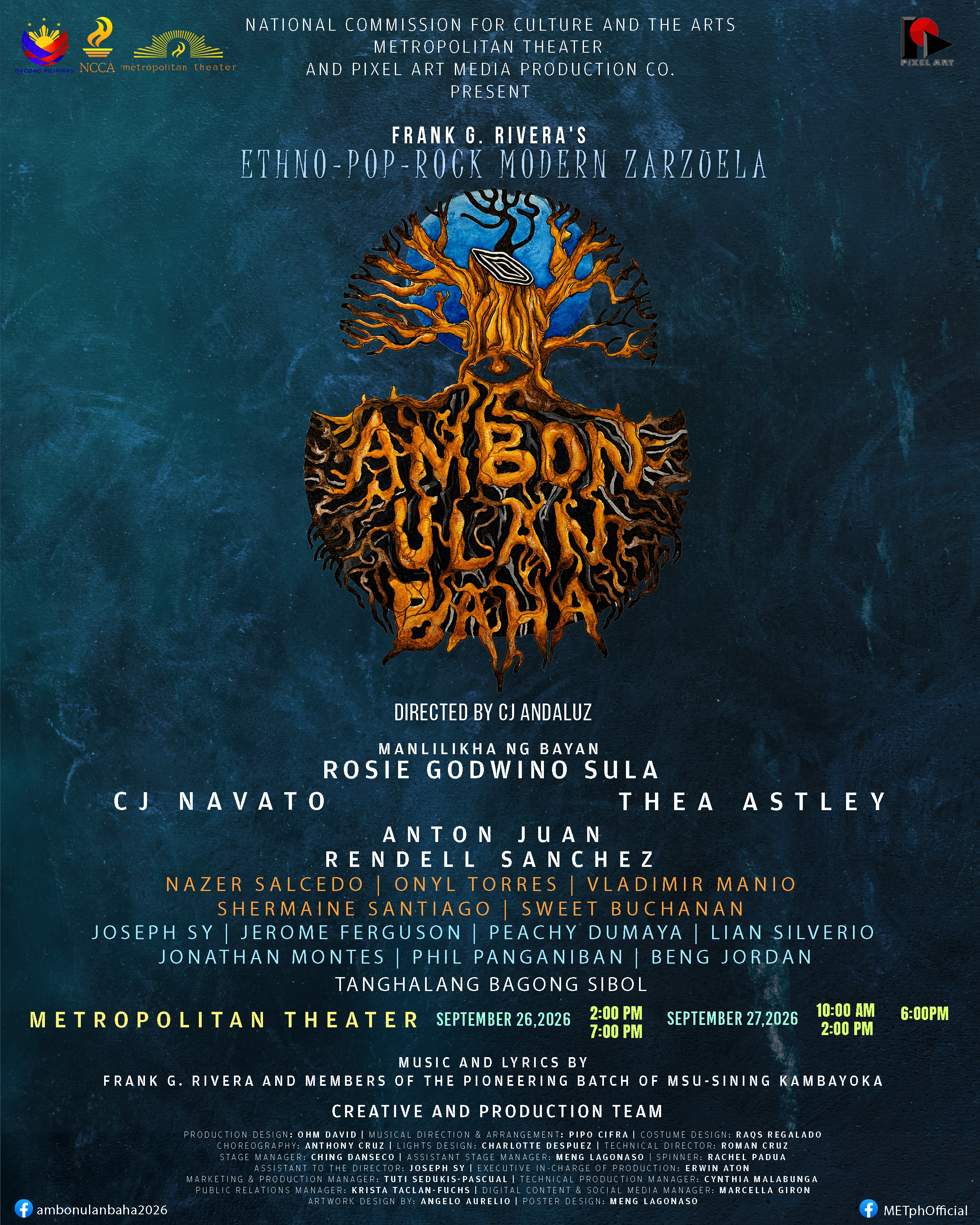
The acclaimed ethno-pop-rock modern zarzuela Ambon, Ulan, Baha, written by multi-awarded playwright Frank G. Rivera, makes a significant full-circle homecoming at the Metropolitan Theater (MET) on September 26 and 27.
Presented by the National Commission for Culture and the Arts (NCCA) and the Metropolitan Theater, and produced by Pixel Art Media Production Co., the Filipino musical returns in a timely reimagining that explores greed, social inequality, and environmental reckoning.
A homecoming three decades in the making
The return carries special significance as Ambon, Ulan, Baha comes back to the MET’s storied halls more than three decades after its last staging there.
In 1992, the musical was presented at the historic theater under Rivera’s helm as founder and artistic director of Teatro Metropolitano, the MET’s resident theater company during its celebrated Second Golden Age. It would become the last production staged at the Metropolitan Theater before the venue closed its doors.
More than three decades later, Ambon, Ulan, Baha returns to the same stage, bringing both the musical and a significant chapter of the MET’s theatrical history full circle.
The 2026 restaging also forms part of the celebrations marking the 52nd anniversary of Sining Kambayoka, the pioneering theater company Rivera founded at Mindanao State University in 1974. Widely regarded as a significant cultural institution, the ensemble is celebrated for its distinctive Kambayoka Theater Form, which weaves together Meranaw chants, folklore, music, and dance into a uniquely Filipino theatrical tradition.
A story with renewed urgency
Ambon, Ulan, Baha follows Nonoy (CJ Navato) and Inday (Thea Astley), two young lovers whose dreams become entangled in promises of progress brought about by a logging concession set in motion by the rich and powerful Don Calixto (Anton Juan) and his son, Doctor Anton (Rendell Sanchez), in the fictional Barrio Magubat.
As ambition, power, and self-interest take hold of the community, forests are stripped bare, traditions fade, and nature ultimately retaliates in a catastrophic flood that forever alters the lives of its people.
Combining stylized minimalism with modern stage technologies, the production transforms the Metropolitan Theater into a living world of rain, memory, destruction, and hope through innovative visual storytelling, immersive projections, and theatrical effects, including rainfall and aerial sequences within the historic venue itself.





An all-Filipino creative force
The production is led by an esteemed artistic team composed of CJ Andaluz (director), Frank G. Rivera (playwright and principal composer), Pipo Cifra (2026 musical arranger and director), Anthony Cruz (choreographer), Ohm David (production designer), Raqs Regalado (costume designer), Charlotte Despuez (lighting designer), and Roman Cruz (technical director), among others.
Joining Navato, Astley, Juan, and Sanchez are Nazer Salcedo as Kapitan Berto, Onyl Torres as Mang Pedro, Shermaine Santiago as Nana Ilyang, and Sweet Buchanan as Nana Maring.
Bringing the community of Barrio Magubat to life is the Taumbayan (Townspeople), an ensemble that brings together alumni of previous Ambon, Ulan, Baha productions and a new generation of performers, including Beng Jordan, Jerome Ferguson, Joseph Sy, Jonathan Montes, Lian Silverio, Peachy Dumaya, and Phil Panganiban.
Completing the company is the Koro (Chorus), composed of members of Tanghalang Bagong Sibol, with lead dancers JM Ursula and Joch Bucacao.
Rooted in Filipino cultural memory
Far from a conventional revival, the new staging also highlights indigenous Filipino expression through traditional chants and musical elements, including the participation of Manlilikha ng Bayan (National Living Treasure) Rosie Godwino Sula, recognized for her mastery and preservation of T’boli epic chanting traditions.
Her involvement further grounds the production in Filipino cultural memory while underscoring the universality of its environmental message.
From Kaingin to Ambon, Ulan, Baha
First written and staged as Kaingin in 1976 as part of Ang Hawla, a trilogy of plays created and performed by MSU-Sining Kambayoka, the work was expanded into the full-length zarzuela Ambon, Ulan, Baha in 1978.
Its original music grew out of Kambayoka’s collaborative tradition, with Rivera composing the majority of the score, including the Ambon, Ulan, Baha theme, the opening prologue, “Tagtuyot,” “Hapdi,” and “Tao’y May Pakpak Din,” alongside contributions from members of the pioneering ensemble.
Emilio “Boy” Nicolasin Jr., the original Nonoy from 1976 onward, composed “Kislap ng Iyong mga Mata,” while the crowd favorite “Kay Hirap Mag-isa” was composed by the late Philip James Tremedal.
A warning that has only grown louder
Created decades before climate change became part of mainstream public discourse, Ambon, Ulan, Baha was already confronting the consequences of environmental destruction, particularly illegal logging and the communities left vulnerable in its wake.
In the years that followed, the Philippines would witness tragedies that chillingly echoed its warnings, from the devastating Ormoc flash floods of 1991 to the typhoons, landslides, and catastrophic floods that continue to displace communities across the country.
Nearly five decades after Ambon, Ulan, Baha first took shape, its message has not faded into history. It has only become more urgent.
The musical’s continued relevance has been affirmed through accolades such as the 2004 Aliw Award for Best Musical Production and the 2012 Fr. Satur Nery Environmental Heroism Award, underscoring its lasting contribution to Philippine theater and environmental consciousness.
For CJ Andaluz, creative director of Pixel Art Media Production Co. and director of the production, the enduring relevance of Ambon, Ulan, Baha lies in its ability to hold a mirror up to contemporary society.
“What once seemed like a cautionary tale has become our present reality. We are no longer standing at the water’s edge. As Filipinos, we have found ourselves increasingly immersed in floods, both literal and metaphorical, that continue to devastate our communities, our livelihoods, and our everyday lives,” Andaluz shared. “Ambon, Ulan, Baha reminds us that every act of progress carries a corresponding responsibility. When development is pursued without regard for ecological balance, even noble intentions can leave irreversible consequences. No one is exempt from the consequences of a wounded planet.”
At its heart, Ambon, Ulan, Baha confronts a difficult truth: environmental destruction is rarely born of malice alone. Often, it is driven by aspirations for progress, modernization, livelihood, and economic opportunity. Yet when development comes at the expense of nature, even well-intentioned decisions can exact a profound cost on both people and the environment.
The musical ultimately asks how many more floods, landslides, and environmental tragedies must occur before we recognize that even the smallest human actions and decisions can alter the delicate balance between humanity and nature.
Nearly five decades after it was first staged, Ambon, Ulan, Baha remains both a cautionary tale and a call to reflection, challenging audiences to confront an uncomfortable but necessary question: Have we truly learned?
Performance Schedule
September 26, 2026
2:00 PM – Ticketed Matinee Performance / Press Preview
7:00 PM – Gala Performance sponsored by the NCCA and MET
September 27, 2026
10:00 AM
2:00 PM
6:00 PM
All performances are ticketed.
Ticket Prices
Available via Ticketnation.ph
Reserved Seating: PHP 1,500
General Admission: PHP 1,000
Tickets: https://bit.ly/aubtickets
Connect
Facebook: Ambon, Ulan, Baha – An Ethno-Pop-Rock Zarzuela (@ambonulanbaha2026)
Instagram: @ambonulanbahamusical
TikTok: @ambonulanbaha2026
#AmbonUlanBaha
#MetropolitanTheater
#PhilippineTheater
#FilipinoMusical
#ClimateChange
#ExpatPhilippines
#ExpatPH
#WhatsOnE